Questions and answers · Records and PRs
What counts as a PR at the gym?
The best you've done in an exercise, measured so it can be compared: the heaviest weight for a given number of reps, the most reps with a given weight, or the heaviest single lift of all. In MassBuilder it's a record when every set goes in full at a weight heavier than your previous best.
A PR only means something if you compare like with like. A 100 kilo squat for one and 90 kilos for five are different achievements, and a half squat can't be compared with a full one. That's why there are several kinds of record.
Three kinds of record
| The record | What it measures | Example |
|---|---|---|
| Weight PR | Heavier for the same number of reps | 100 kg × 5 after 97.5 kg × 5 |
| Rep PR | More reps with the same weight | 100 kg × 7 after 100 kg × 5 |
| Estimated one-rep max | What you could probably lift once | 90 kg × 5 gives about 105 kg |
The estimated max uses the Epley formula, the weight times one plus the reps divided by thirty. With 100 kilos, three reps make 110 kilos, five reps 116.7 and ten reps 133.3. The more reps, the further from the set the guess lands.
How you see your records in MassBuilder
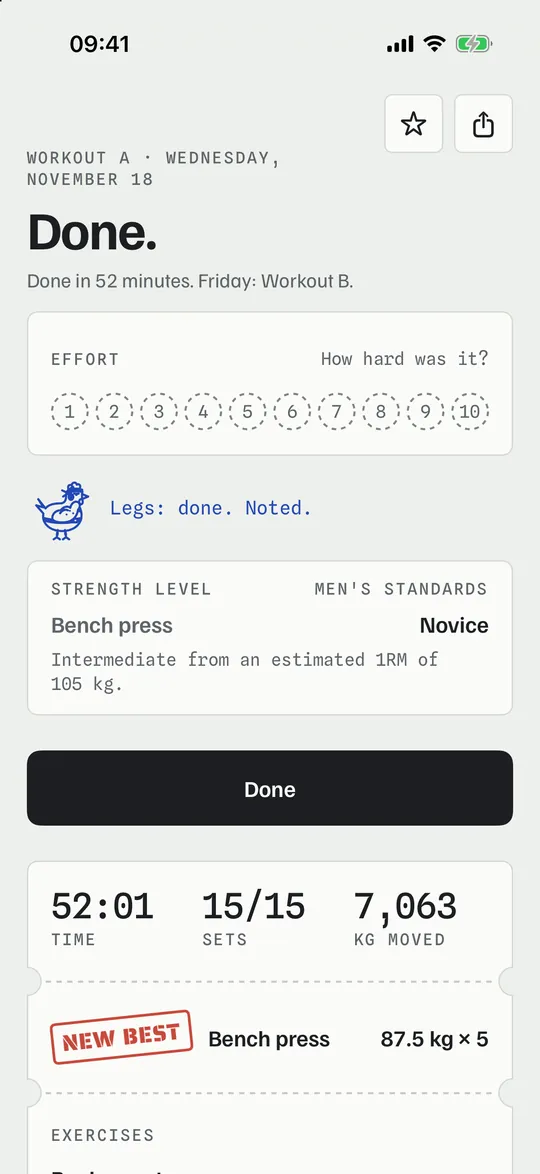
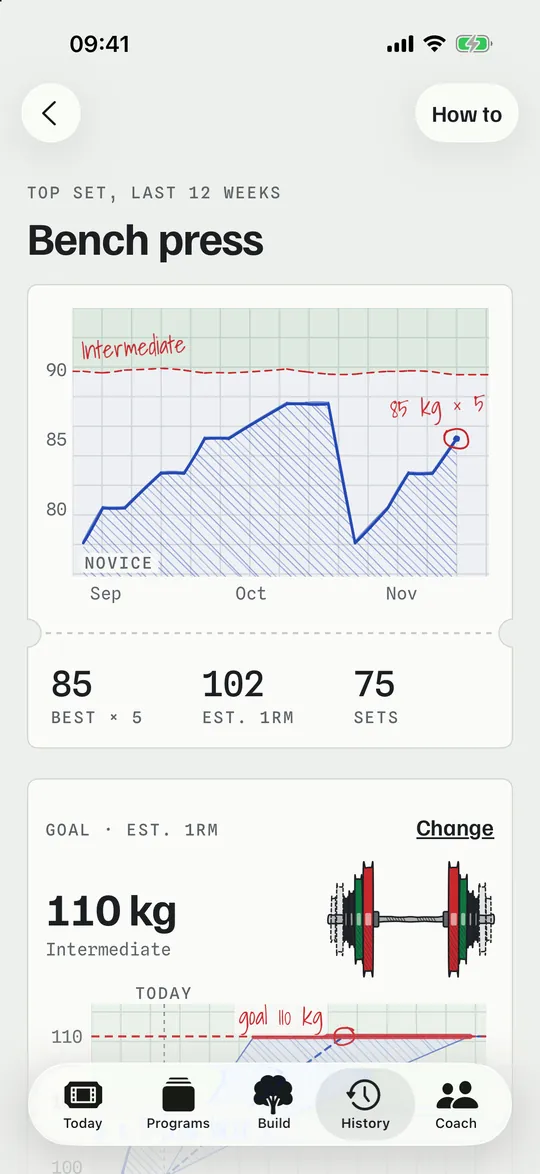
When a workout sets a record, it says so on the summary after the workout, and the exercise's card shows your record while you lift. Every lift also has its own chart with your top sets from the last twelve weeks, your best set and your estimated max.
More questions on the same thing
- What's the difference between a weight PR and a rep PR?
- A weight PR is lifting heavier than before for the same number of reps, like 100 kilos for five instead of 97.5. A rep PR is doing more reps than before with the same weight, like 100 kilos for seven instead of five. Both mean you've got stronger in the exercise.
- Why does the app show a different max from what I've lifted?
- Because it's an estimate. MassBuilder works out your max from your sets with the Epley formula: the weight times one plus the reps divided by thirty. Five reps with 90 kilos gives 105 kilos, even though you've never lifted 105 once. The more reps in the set, the further the formula has to guess.
- Does a PR count if I used lifting straps?
- That's up to you, but compare like with like. Straps help your grip, so a deadlift with straps and one without are really two different records. Write down which it was, so you know what you're comparing with next time.
- How often can you set a PR?
- Often at first. MassBuilder raises the weight for the next workout when every set goes in full, and every workout where the heavier weight goes in full is a record. Later they come further apart, and then a rep PR counts too. After two misses in a row at the same weight, MassBuilder suggests a lighter weight so you can build back up towards the record.
- Should I test my one-rep max?
- You don't have to. A heavy set of three to five reps gives an estimate of your max without lifting it. If you want to test anyway: warm up properly, have a spotter or safety bars, and stop when your technique starts to give.
- Does a PR count if I didn't go all the way down?
- Not if you compare it with reps where you did. Decide what a rep is, for example that your hip goes down to at least knee height in the squat, and stick to it. MassBuilder's form check measures depth exactly that way and shows for each rep whether it was enough.
This answer was written with Claude and checked against the app (version 4.0) and the sources. Found a mistake? Write to oskar.ege@icloud.com.