Questions and answers · Motivation and habit
How do I work out when I don't feel like it?
Don't wait for the desire, and make the start small: change, warm up and do the first set, a little lighter than usual if you like. The beginning is usually the hard part, and people underestimate how much they will enjoy the workout. If it still feels wrong after ten minutes, you may stop. Being ill or in pain is not the same as not feeling like it, and then you rest.
Not feeling like it is the normal state. In four studies with 279 adults at the University of British Columbia, participants consistently underestimated how much they would enjoy exercising, from yoga and Pilates to aerobic exercise and weight training. The researchers argue that we give the beginning of a workout too much weight, and the beginning is usually the unpleasant part. So the reluctance beforehand is a poor forecast.
- MotivationThe sun
- DisciplineThe stake
- RoutineThe trunk
- IdentityThe tree, by itself
Three ways through the day
- Make the start small. Promise yourself only to change and warm up, and remind yourself how it usually feels afterwards.
- Lower the intensity, not the attendance. A review of 33 studies, mostly on aerobic exercise, shows that most people find exercise pleasant below a certain intensity and unpleasant above it. When you choose the intensity yourself, you seem to tolerate more.
- Decide when, where and how in advance, for example that you change clothes as soon as you get home. A review of 13 randomised trials found that such plans, with follow-up, gave a small effect: 0.25.
Our rule of thumb: go for ten minutes, and if it still feels wrong, you may stop. Being ill or in pain is not the same as not feeling like it. Rest then, and ask whoever treats you about pain or injury.
The rule of thumb is ours, not research.
How it looks in MassBuilder
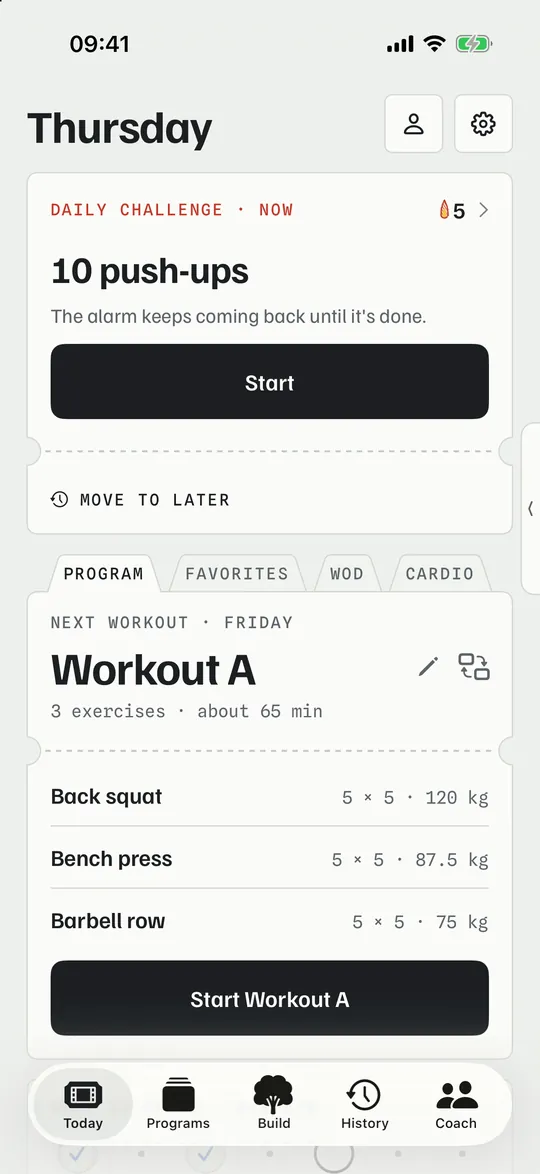
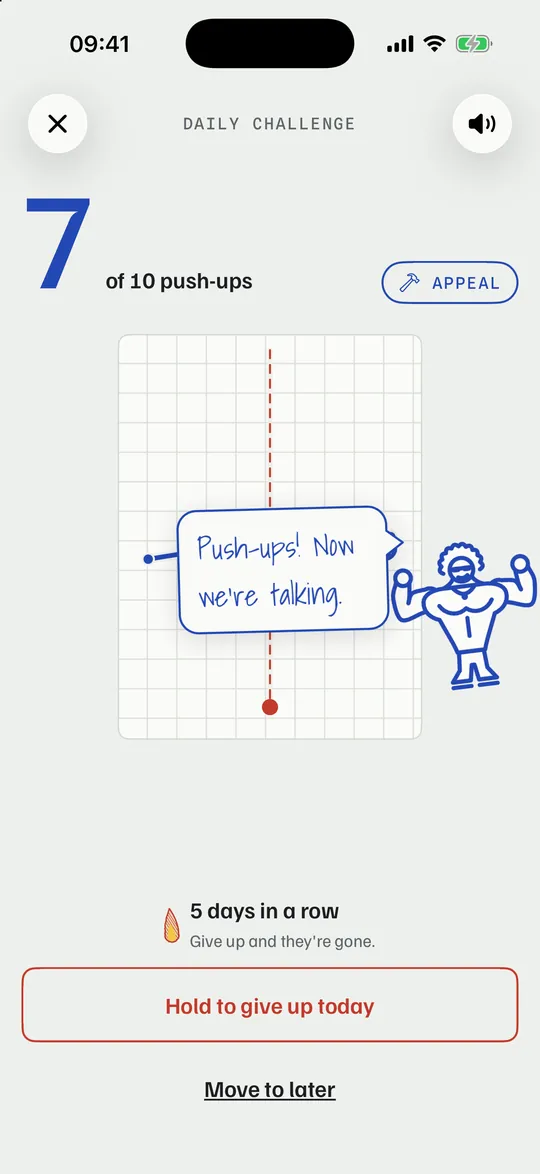
The daily challenge breaks through silent mode. From half an hour before the alarm it can't be made easier, so you can't bargain it down when the desire runs out. With Lock apps, the apps you picked close when the alarm rings. Choose One workout and they open only once you have trained.
The app doesn't give you the desire, it only removes the decision. Give up today is always there: you hold the button for five seconds, and it costs a missed day or the amount you picked in advance.
More questions on the same thing
- Should I work out even when I don't feel like it?
- Yes, if you are healthy. How you feel before a workout is a poor forecast, and in studies people underestimated how much they would enjoy exercising. Start small and decide after ten minutes.
- Does a lighter session count?
- Yes. A lighter session is still a session, and most people find exercise more pleasant below a certain intensity. Choose the pace yourself that day.
- How long should I keep going before I stop?
- Our rule of thumb is ten minutes: the warm-up and the first set. If it still feels wrong, you may stop. It isn't research, just a limit that makes the start easier to take.
- What if I'm ill or in pain?
- Then it isn't reluctance, and you rest. For pain or injury, ask whoever treats you. MassBuilder has Pause mode, which lasts a week and can be extended a week at a time. Paused days don't break the streak.
- Can I put off today's challenge?
- Once a day, with Move to later, to 11:50 PM the same day at the latest. From half an hour before the alarm it can't be made easier. If you won't do it at all, hold Give up today for five seconds.
- Will the desire come back?
- It comes and goes. Step two is about not letting your training depend on it. So set the time and number while the desire is there, see how to decide in advance.
Sources
- Ruby et al. (2011): The invisible benefits of exercise. Health Psychology.
- Ekkekakis et al. (2011): The pleasure and displeasure people feel when they exercise at different intensities: decennial update and progress towards a tripartite rationale for exercise intensity prescription. Sports Medicine.
- Silva et al. (2018): Impact of implementation intentions on physical activity practice in adults: A systematic review and meta-analysis of randomized clinical trials. PLoS One.
This answer was written with Claude and checked against the app (version 4.0) and the sources. Found a mistake? Write to oskar.ege@icloud.com.