Questions and answers · Push-ups
What is proper push-up form?
Place your hands about shoulder width apart, directly under your shoulders, and keep your body straight from head to heels. Lower until your elbows are at roughly a right angle or your chest nearly reaches the floor, then press up to straight arms. If that is too heavy, do them on your knees or with your hands on something higher instead of cutting the movement short. In MassBuilder a slider in five steps, from Gentle to Very strict, decides how deep and how straight the camera requires.
A push-up is correct when it goes all the way and your body moves as one piece:
- Hands. About shoulder width, directly under your shoulders. That is where the hands were in the study below.
- Body. Straight from head to heels, without sagging hips.
- Elbows. Angled back, not straight out to the sides.
- Down. Until your elbow is at roughly a right angle, or until your chest nearly reaches the floor.
- Up. All the way to straight arms.
Points 2 and 3 are common coaching rules of thumb, not research.
How heavy is each variant?
Wurm and colleagues used a force platform to measure the peak share of body weight carried by the hands in 23 recreationally fit young adults.
- 74% feet up 61 cm (24 in)
- 70% feet up 30 cm (12 in)
- 64% regular push-up
- 55% hands up 30 cm (12 in)
- 49% knee push-up
- 41% hands up 61 cm (24 in)
All the differences were statistically significant. The researchers conclude that you should start with hands elevated or on your knees, then move to regular push-ups and finally to feet elevated. Another study, with eight healthy young volunteers, found higher activation in the triceps and the pectoralis major with a narrow hand placement.
What the camera counts
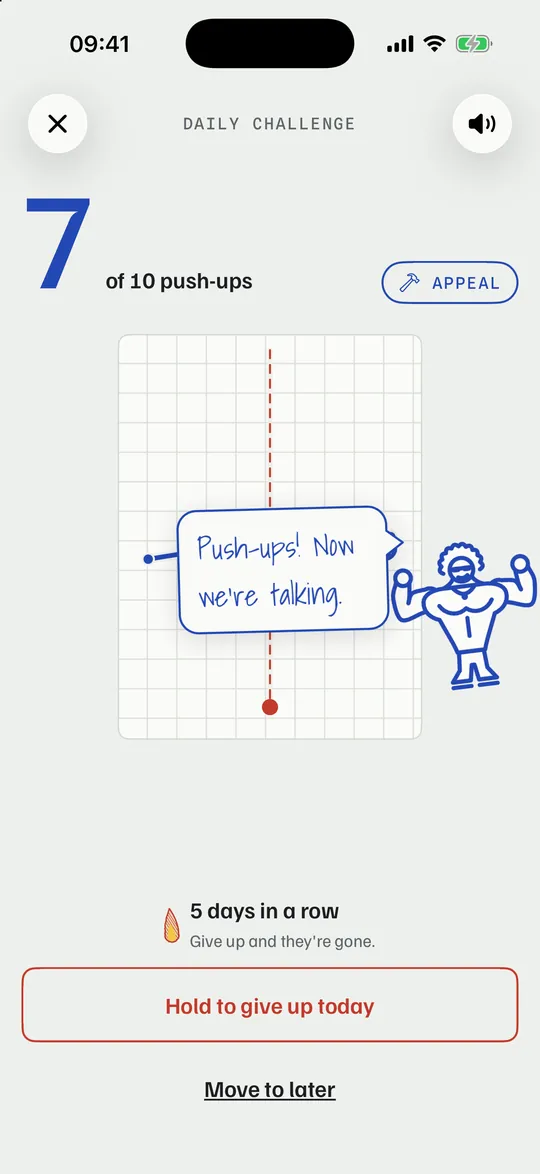
The front camera counts your reps in the daily challenge. Stand the phone upright and still, about two steps away and facing you. A push-up is from straight arms down to roughly a right angle at the elbow and up again, with your hands still on the floor. The slider moves the bar:
| Step | How deep | Knees may be on the floor | Straight body required |
|---|---|---|---|
| Gentle | roughly halfway down | yes | no |
| Relaxed | stricter than Gentle | yes | no |
| Standard | stricter than Relaxed | yes | no |
| Strict | stricter than Standard | no | yes |
| Very strict | chest nearly to the floor | no | yes |
Up to Standard an honest attempt is enough. No step is fully cheat-proof.
What the app doesn't do
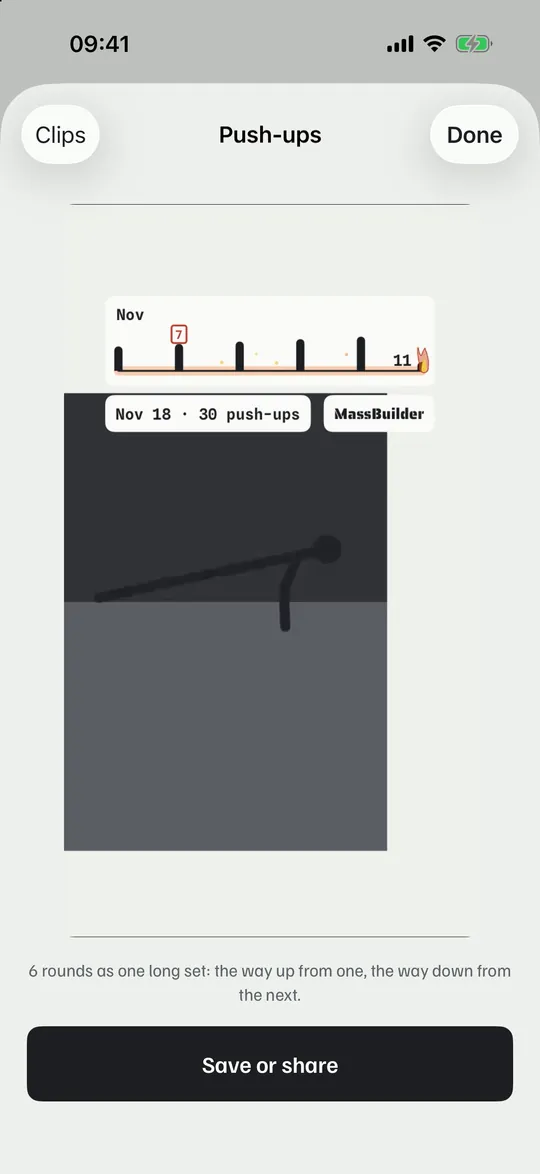
The form check covers eight lifts, such as squat and deadlift, but not push-ups. The camera counts and judges by the slider, but gives no rep-by-rep review. In the timelapse you can look back at one rep per round, saved as a clip only on the phone.
More questions on the same thing
- How far from the phone should you stand?
- About two steps away, preferably facing the phone. Stand it upright so it stays still. The counting happens on the phone and no image is sent anywhere.
- Does your chest have to touch the floor?
- No. A common limit is the elbow reaching roughly a right angle, and that is also what the camera counts as a push-up. Only Very strict requires the chest to go nearly all the way to the floor.
- Where should your elbows point?
- A common rule of thumb is angled back, not straight out to the sides. The studies above did not compare elbow direction, so it is coaching advice and not a research finding.
- How fast should each push-up be?
- There is no fixed rule. In the study by Wurm and colleagues each rep took 2 seconds, set by a metronome. A steady pace is a rule of thumb that makes it easier to keep your form.
- Can you lower the slider if it feels heavy?
- Not at any time. From half an hour before the alarm until the day's challenge is done or given up, it can't be changed to fewer reps or a milder judgement. A stricter step can always be chosen.
- What if it hurts?
- Ask whoever treats you before you continue. Pain in wrists, elbows or shoulders is not the same as being tired.
Sources
- Wurm et al. (2010): Kinetic analysis of several variations of push-ups. 28th International Conference on Biomechanics in Sports (ISBS), Conference Proceedings.
- Marcolin et al. (2015): Selective Activation of Shoulder, Trunk, and Arm Muscles: A Comparative Analysis of Different Push-Up Variants. Journal of Athletic Training.
This answer was written with Claude and checked against the app (version 4.0) and the sources. Found a mistake? Write to oskar.ege@icloud.com.