Questions and answers · Your build and your lifts
Do long femurs make squats harder?
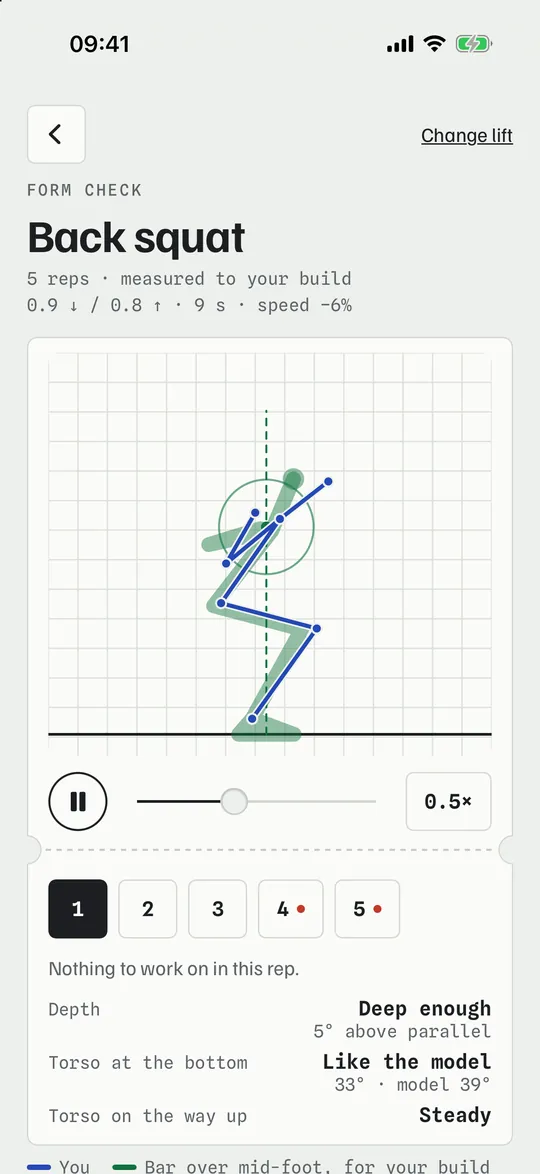
They don't make your squat wrong, but they change how it looks. With long thighs relative to your torso, your hips travel further back as you go down, and to keep the bar over the middle of your foot, your torso has to lean further forward. That's geometry, and your hips and back then do a bigger share of the work.
Two people with the same strength and the same technique can look completely different in a squat. That's because the bar has to stay over the middle of your foot through the whole movement, and how your body solves that depends on how long your thighs, shins and torso are relative to each other.
What your proportions do to the lifts
| Build | What happens |
|---|---|
| Long thighs | Your hips go further back in the squat, and your torso leans further forward |
| Long torso | Your torso can stay more upright in the squat |
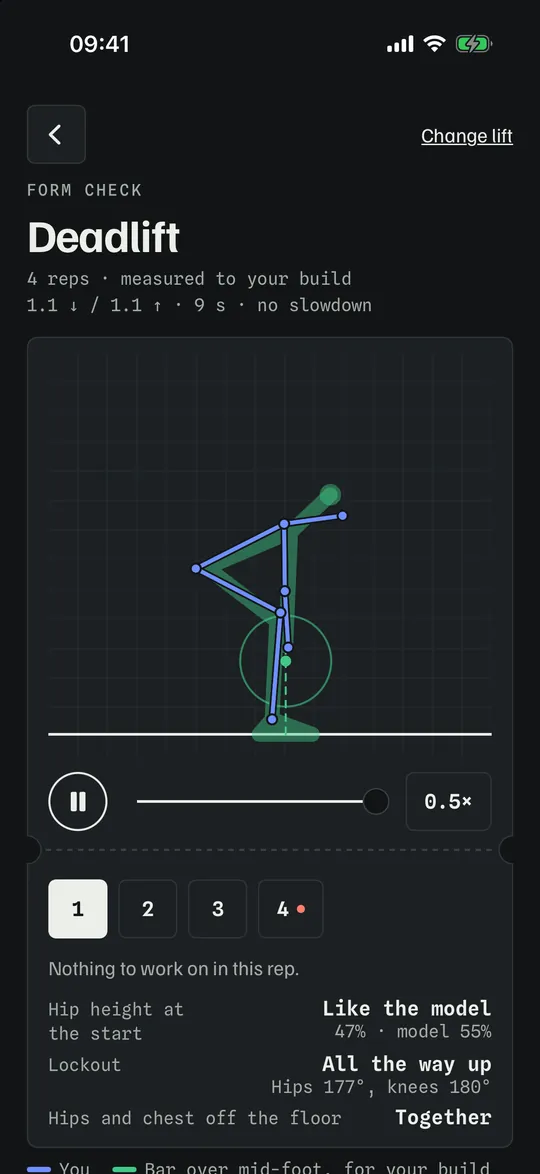
| Long arms | The deadlift starts with higher hips and has a shorter way up |
| Short arms | The bench press has a shorter way from your chest to straight arms |
So the lean isn't a fault in itself. What counts is that the bar moves straight, that you reach depth and that your torso keeps the same angle on the way up as on the way down. A common fault is the hips shooting up first so the torso tips forward out of the bottom.
How MassBuilder measures your build
The form check starts with you standing still, side-on, for a couple of seconds while the app measures your shins, thighs, torso and arms. Then every rep is compared with a model built from your measurements: in the squat, your depth, your torso's lean against the model's and that the lean doesn't increase on the way up. Long thighs don't count as a fault.
More questions on the same thing
- Are long arms an advantage in the deadlift?
- Yes, geometrically. With long arms the bar hangs lower, so you can start with your hips higher and your torso more upright, and the bar has a shorter way to travel to lockout. In MassBuilder's form check, your hip height at the start is compared with a model built from your measurements, so long arms don't count as a fault.
- Are short arms an advantage in the bench press?
- Yes, geometrically. The bar has a shorter way to travel from your chest to straight arms, so each rep takes less work with the same weight. Long arms don't make your bench press wrong, just longer.
- How wide should my feet be in a squat?
- There's no width that suits everyone. Start about shoulder width with your toes turned out a little, and adjust until you reach depth with your heels down and your knees pointing the same way as your toes. A wider stance with your toes turned out more makes your thighs shorter seen from the side, which gives your hips more room. In MassBuilder's form check, depth counts when your hip is at least at knee height.
- Why does my squat look different from the ones on YouTube?
- Because you're built differently. The length of your thighs, shins and torso decides how far forward you have to lean to keep the bar over the middle of your foot. Where the bar sits on your back, your shoes and your stance matter too. Compare yourself with a model of your own body instead: MassBuilder's form check draws one from your measurements.
- Can an app measure my body proportions?
- MassBuilder's form check does. You put your phone on the floor, side-on, and stand still for a couple of seconds while the app measures your shins, thighs, torso and arms. The model and the advice then start from your proportions, and you can measure again if the phone was in an odd spot.
- Should I pick sumo or conventional deadlift based on my build?
- Try both. Cholewa et al. had 47 men and women who had never deadlifted learn both styles and test a one-rep max in each, and the group was equally strong in both. The only body measure linked to which style went better was sitting height relative to total height, in other words how long the torso is, and the link was weak. The authors suggest sumo may give a slight edge with a long torso, and conventional with a short one.
Sources
This answer was written with Claude and checked against the app (version 4.0) and the sources. Found a mistake? Write to oskar.ege@icloud.com.