Questions and answers · Pull-ups
How do I go from one pull-up to ten?
Do a few pull-ups several times a day and end every round well before you stall. Frequent rounds help because more total volume fits, and in one study stopping the set early gave more than going close to failure. Raise the number once it has felt easy for a while, or let Grow at my pace do it.
Ten pull-ups are built from many easy reps, not from a few attempts to failure. Do a few several times a day and end every round before it gets slow. If you cannot do one yet, start with the first pull-up.
What the research says
A review of 22 studies found larger strength gains the more sessions per week, measured as effect size:
- 0.74 1 session a week
- 0.82 2 sessions a week
- 0.93 3 sessions a week
- 1.08 4 sessions or more
But in the studies where total volume was equal, frequency had no significant effect. Training often helps because more reps fit.
In another study, 29 strength-trained men trained pull-ups for 8 weeks. The group that stopped each set when rep velocity had dropped 25 percent improved in every measured variable, including strength and number of reps. The group that went on to 50 percent, closer to failure, stayed the same. The participants could already do 15.9 on average, so the result does not automatically apply to someone who can do one. In a third study, 8 weeks of lat pulldowns increased the number of pull-ups in 34 recreationally active male students.
Our rule of thumb
| You can do in one go | Per round | Rounds a day |
|---|---|---|
| 1 | 1 | 3 to 5 |
| 2 to 3 | 1 | 4 to 6 |
| 4 to 6 | 2 to 3 | 3 to 4 |
| 7 to 9 | 3 to 4 | 3 to 4 |
The rule of thumb is ours, not research. The idea is sometimes called grease the groove: about half your max per round, several rounds, never to failure.
How it looks in MassBuilder
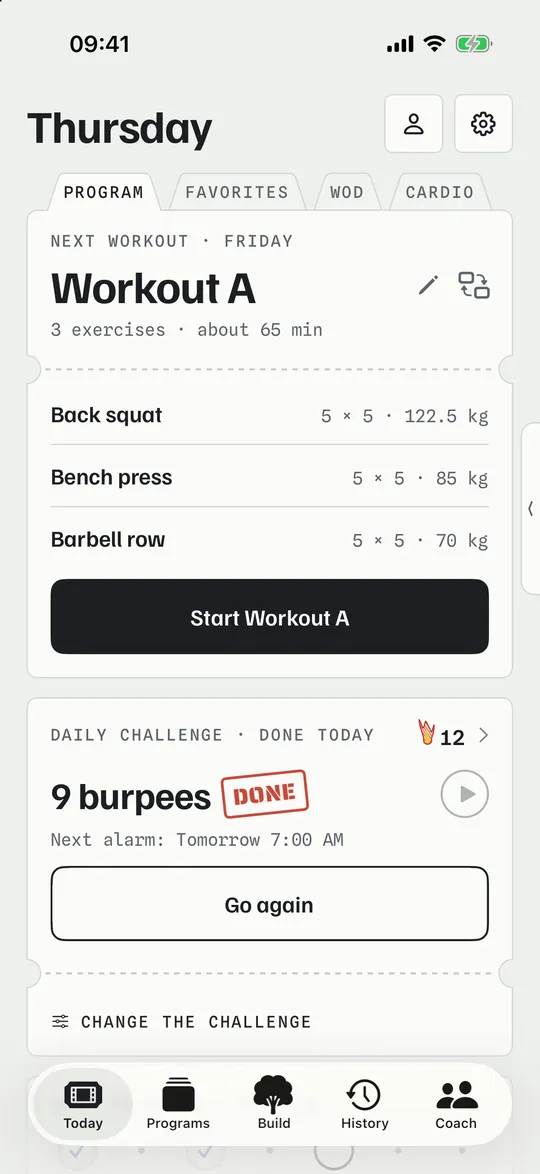
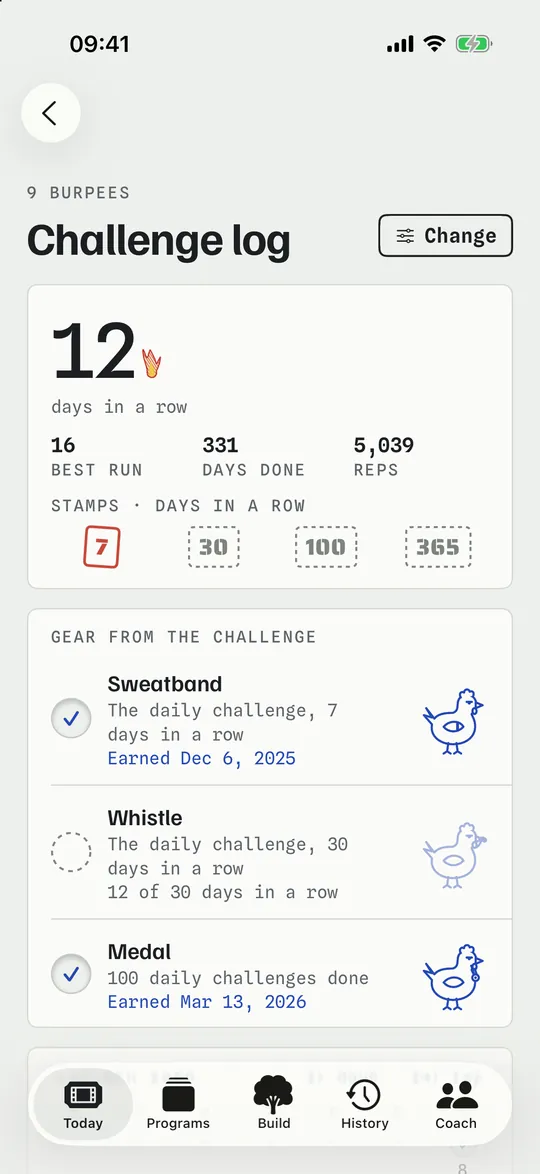
In the daily challenge you pick pull-ups and a number from 1 to 100. The app suggests 5. The reps from every round are saved and the count continues. The camera counts from a hang with straight arms until your head has moved up toward your hands, and it judges pull-ups more gently than other exercises because it sees them less well.
With Grow at my pace, the app raises the number for you, based on how fast today's reps go compared with your usual pace. It doesn't measure how the speed drops within a set, as in the study. In workouts you can turn on Reps in the tank and enter after each set how many reps were left. If your shoulder or elbow hurts: cut back or rest and ask whoever is treating you. With Pause mode, those days do not break your run of days.
More questions on the same thing
- Can I do pull-ups every day?
- Yes, if every round ends well before you stall. In a review of 22 studies, the advantage of frequent sessions disappeared when total volume was equal, so the point of training often is that more reps fit. If it hurts: cut back or rest and ask whoever is treating you.
- Should I take every set to failure?
- No. In a study of trained men who could do 15.9 pull-ups on average, the group that stopped the set at 25 percent velocity loss improved, while the group that went on to 50 percent stayed the same.
- How many pull-ups should I do per round?
- Our rule of thumb, not research: about half of what you can do in one go, and at least one.
- Do pull-ups I split over the day count?
- Yes. MassBuilder saves the reps from every round and keeps counting where you left off.
- Does MassBuilder raise the number for me?
- Yes, if you turn on Grow at my pace. Every day at your usual pace the number grows by 2 percent, and by at least one rep per seven such days. A day that is at least a quarter slower, or done in several rounds, keeps the number, and two such days in a row lower it by 10 percent. Without Grow at my pace you raise it yourself. More reps or stricter judging can always be chosen, but from half an hour before the alarm until today's challenge is done or given up, it cannot be lowered.
- How strict is the camera?
- The slider has five steps, from Gentle to Very strict. Gentle counts a pull-up when your head nears your hands, and up to Standard an honest attempt is enough. Nothing is fully cheat-proof. Counting happens on the phone and no image is sent anywhere.
Sources
- Sánchez-Moreno et al. (2020): Effects of Velocity Loss During Body Mass Prone-Grip Pull-up Training on Strength and Endurance Performance. Journal of Strength and Conditioning Research.
- Grgic et al. (2018): Effect of Resistance Training Frequency on Gains in Muscular Strength: A Systematic Review and Meta-Analysis. Sports Medicine.
- Li et al. (2025): Eight-week lat pull-down resistance training with joint instability leads to superior pull-up endurance performance and reduced antagonist coactivation in recreationally active male college students. European Journal of Sport Science.
This answer was written with Claude and checked against the app (version 4.0) and the sources. Found a mistake? Write to oskar.ege@icloud.com.