Questions and answers · Food and protein
What's the easiest way to count macros?
Count protein first and let the rest be approximate. Log by saying or photographing what you ate instead of weighing everything, and reuse the meals you eat often. If you train, 1.4 to 2.0 grams of protein per kilo of body weight a day is enough, according to the International Society of Sports Nutrition.
Start with one number
Macros are protein, carbs and fat. Hitting all three to the gram every day is a full-time job. Protein is the one that is hardest to get enough of by accident, so start there.
- 1.4–2.0 g protein per kilo a day if you train
- 1.6 g where the benefit for muscle levels off
- 49 studies behind that figure
The figure 1.6 comes from a meta-analysis of 49 studies with 1,863 participants: more protein than about 1.6 grams per kilo a day did not build more muscle from strength training. If you weigh 80 kilos, that is about 130 grams a day.
Three shortcuts
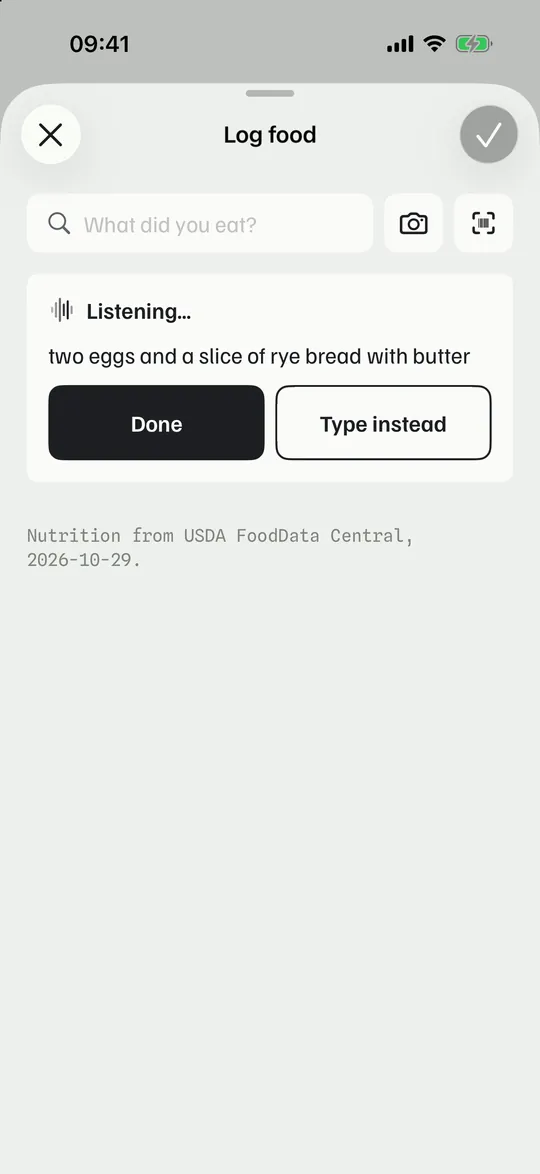
- Say it or snap it. It is faster than searching for every item.
- Save what you eat often. Breakfast is often the same every day. Log it once.
- Scan the barcode. Then the nutrition values are already there.
Fuel in MassBuilder
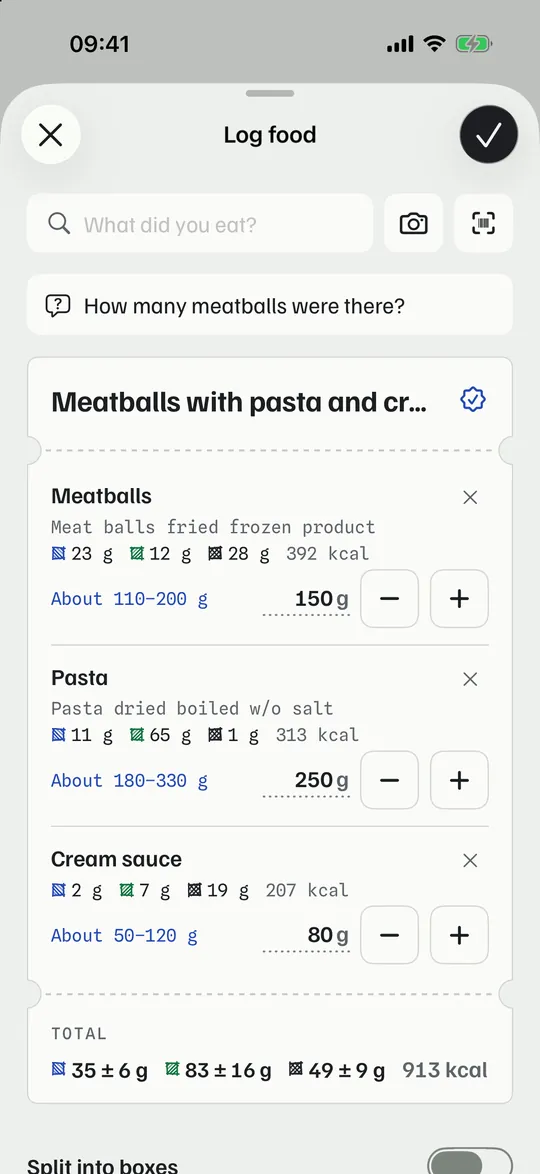
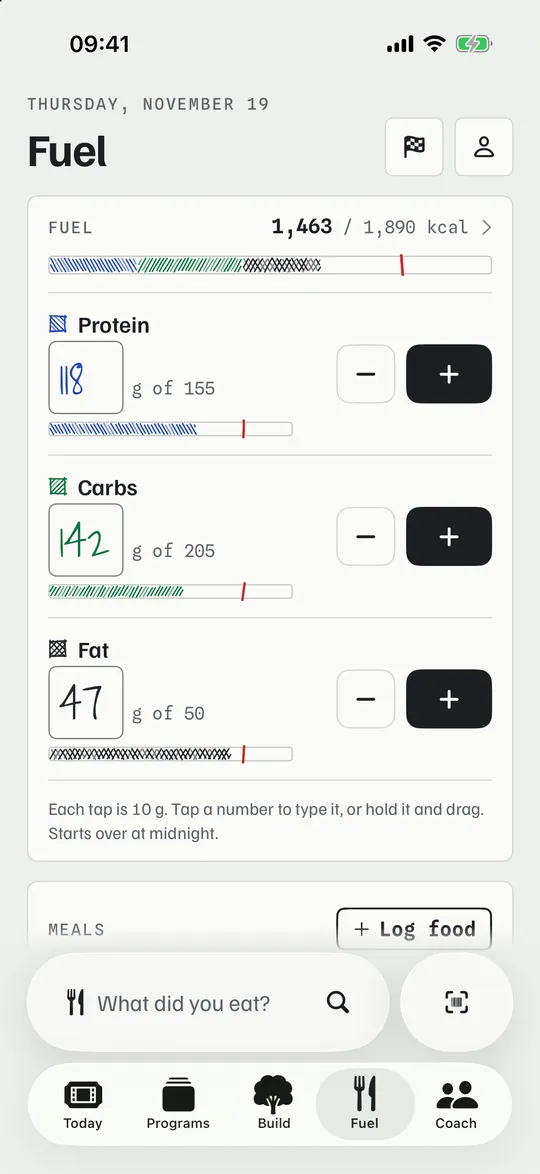
Fuel is the food part of MassBuilder. You can search, scan the barcode or type it in by hand. With Pro you can also say or photograph what you ate: the AI then picks the foods and the grams, and the nutrition values come from the database instead of being guessed.
The app works out daily targets for you. Protein is set to 1.6 grams per kilo if you are holding or gaining weight, and to 2.0 grams per kilo of goal weight if you are losing. You can change it yourself, between 1.2 and 2.4.
More questions on the same thing
- How much protein do I need if I work out?
- 1.4 to 2.0 grams per kilo of body weight a day is enough for most people who train, according to the International Society of Sports Nutrition. Above about 1.6, more protein doesn't build more muscle, according to a meta-analysis of 49 studies.
- Do I have to weigh my food?
- Not to get started. Rough amounts logged every day are worth more than exact ones logged for three days. Weigh what you eat often once, and then you know.
- How accurate is logging by photo?
- The amount is an estimate, so look at the grams and correct them if needed. In MassBuilder the nutrition values come from the food database, not from a guess.
- How do I set my macro targets?
- Start with protein from your weight. MassBuilder then sets fat to 25 percent of the day's calories and gives carbs the rest, and you can change both protein and fat yourself.
- Do I need to count macros to build muscle?
- No. Eating enough and getting your protein is sufficient. Counting for a while teaches you how much that is, and then you can stop.
- Can the app tell me when I'll reach my goal weight?
- Yes. Fuel shows a forecast with an honest range instead of an exact date.
Sources
- Jäger et al. (2017): International Society of Sports Nutrition Position Stand: protein and exercise. Journal of the International Society of Sports Nutrition.
- Morton et al. (2018): A systematic review, meta-analysis and meta-regression of the effect of protein supplementation on resistance training-induced gains in muscle mass and strength in healthy adults. British Journal of Sports Medicine.
This answer was written with Claude and checked against the app (version 4.0) and the sources. Found a mistake? Write to oskar.ege@icloud.com.