Questions and answers · Cardio and strength
Does running ruin your strength gains?
Not your muscle or your maximal strength, according to a review of 43 studies. Schumann et al. found that cardio alongside strength training reduced neither muscle growth nor maximal strength. Explosive strength did take a small hit, most when both were done in the same session.
There's an old rule in the gym that cardio eats muscle. It comes from studies showing that people who train both strength and endurance can end up with less strength than those who only lift. Newer reviews paint a more nuanced picture.
What the research says
| The study | What it found |
|---|---|
| Schumann et al. 2022, 43 studies | No reduction in muscle growth or maximal strength. Explosive strength took a small hit, most in the same session. No difference between running and cycling. |
| Lundberg et al. 2022, 15 studies | Muscle fibers grew a little less, the slow-twitch fibers most clearly with running |
| Wilson et al. 2012, 21 studies | Running, but not cycling, reduced growth and strength, and the more often and longer, the more |
| Eddens et al. 2018, 10 studies | Strength before cardio in the same session gave more leg strength. No difference for muscle. |
Taken together, cardio alongside lifting looks like it costs your muscles little or nothing. If you want to maximize explosiveness, or you lift heavy with your legs the same day, it helps to put the run after lifting or on another day.
Cardio in MassBuilder
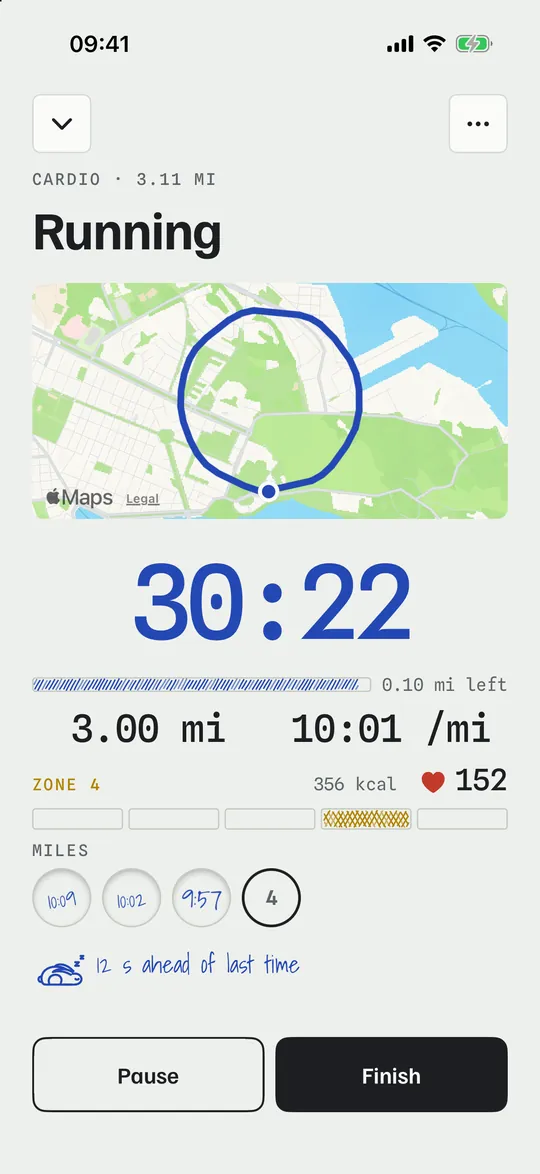
Cardio sits next to Programs and WOD. You go by time, distance, zones or intervals, and afterwards you get a receipt with your route, your laps and your heart rate. Outdoors, GPS draws your route, and workouts from a Garmin or another sports watch can be brought in as FIT files.
More questions on the same thing
- Should I run before or after lifting?
- If leg strength matters most, lift first. Eddens et al. went through ten studies of sessions with both, and strength before cardio gave about 7 percent more gain in dynamic lower-body strength. For muscle growth, fitness and body fat, the order made no difference.
- Is cycling better than running if I want to build muscle?
- The research doesn't agree. An older review by Wilson et al. found that running, but not cycling, reduced muscle growth and strength when combined with strength training. Schumann et al. found no difference between running and cycling. Lundberg et al. saw that slow-twitch muscle fibers grew less with running, but not with cycling.
- Can I log runs in the same app as my lifting?
- Yes, in MassBuilder. Cardio sits next to Programs and WOD, and running, cycling, rowing, the ski erg and more count in your week and your streak. You go by time, distance, zones or intervals and get a receipt afterwards with your route, your laps and your heart rate. Workouts from a Garmin or another sports watch can be brought in as FIT files.
- Can I see my run on a map afterwards?
- Yes. Outdoors, MassBuilder draws your route with GPS, and the receipt after the workout shows your route, your laps and your heart rate. The route stays on your phone, and in Apple Health if you save workouts there.
- How much cardio do I need if I lift?
- The WHO recommends all adults get 150 to 300 minutes of moderate or 75 to 150 minutes of vigorous aerobic activity a week, or a mix, and muscle-strengthening activity at least two days a week. Lifting covers the muscle-strengthening part, not the cardio.
- Does cycling to work count as cardio?
- Yes, if the ride gets your heart rate up. The WHO guidelines count minutes at moderate or vigorous intensity and say that some activity is better than none. If you record the ride as a workout in another app that saves to Apple Health, MassBuilder can count it in your week and your streak if you turn on Count workouts from other apps.
Sources
- Schumann et al. (2022): Compatibility of Concurrent Aerobic and Strength Training for Skeletal Muscle Size and Function: An Updated Systematic Review and Meta-Analysis. Sports Medicine.
- Eddens, van Someren and Howatson (2018): The Role of Intra-Session Exercise Sequence in the Interference Effect: A Systematic Review with Meta-Analysis. Sports Medicine.
- Wilson et al. (2012): Concurrent training: a meta-analysis examining interference of aerobic and resistance exercises. Journal of Strength and Conditioning Research.
- Lundberg et al. (2022): The Effects of Concurrent Aerobic and Strength Training on Muscle Fiber Hypertrophy: A Systematic Review and Meta-Analysis. Sports Medicine.
- Bull et al. (2020): World Health Organization 2020 guidelines on physical activity and sedentary behaviour. British Journal of Sports Medicine.
This answer was written with Claude and checked against the app (version 4.0) and the sources. Found a mistake? Write to oskar.ege@icloud.com.