Questions and answers · Muscle and weight on Ozempic
Do you lose muscle on Ozempic?
Yes, some. In the STEP 1 study of semaglutide, the drug in Ozempic and Wegovy, 38 percent of the weight lost was lean mass, and about half of that is muscle. The loss mostly follows from losing a lot of weight and eating less, and you can influence it with strength training and enough protein.
Lean mass is everything that isn't fat: muscle, but also organs, bone and fluid. Studies of GLP-1 drugs measure it with DXA, an X-ray scan that separates fat from the rest.
- 38% of the weight lost was lean mass in STEP 1 (semaglutide)
- 25% in SURMOUNT-1 (tirzepatide)
- about 20% of the weight lost is estimated to be muscle in STEP 1
In STEP 1, where participants took semaglutide, those in the DXA substudy lost 13.6 kilos on average: 8.3 kilos of fat and 5.3 kilos of lean mass. About half of lean mass is muscle, so roughly 20 percent of the weight lost is estimated to be muscle. In SURMOUNT-1 with tirzepatide, the drug in Mounjaro, about 75 percent of the weight lost was fat and 25 percent lean mass, with both the drug and placebo.
Is it the drug or the weight loss?
Mostly the weight loss. All weight loss takes some muscle with it, and a review of the studies found that muscle volume drops by about as much as you would expect from age, disease and how much weight was lost. With the drug you can lose a lot, and you eat less of everything, protein included. Another review estimates that trial participants lost at least 10 percent of their muscle mass, about the same as twenty years of ageing.
What protects your muscle
- Strength training. Four American organizations in obesity, nutrition and lifestyle medicine recommend strength training at least three times a week for people taking these drugs. Read more in Should I strength train while taking Ozempic?
- Protein. The same advisory mentions 1.2 to 1.6 grams per kilo a day during weight loss. See how much protein you need.
- Strength as your measure. The scale doesn't tell you what was lost. Your strength is a measure you can follow every week.
How MassBuilder helps
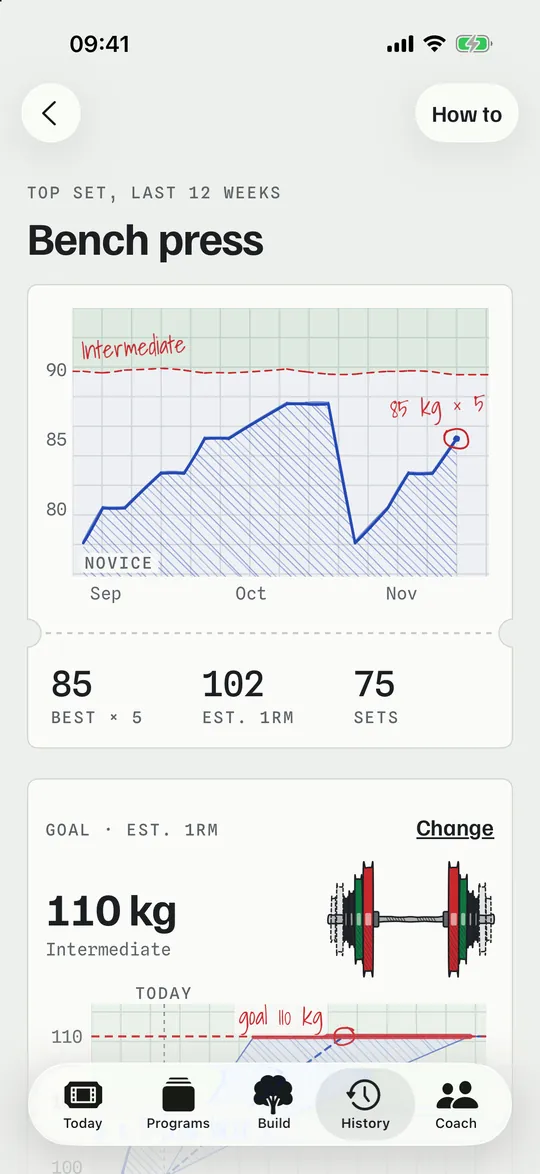
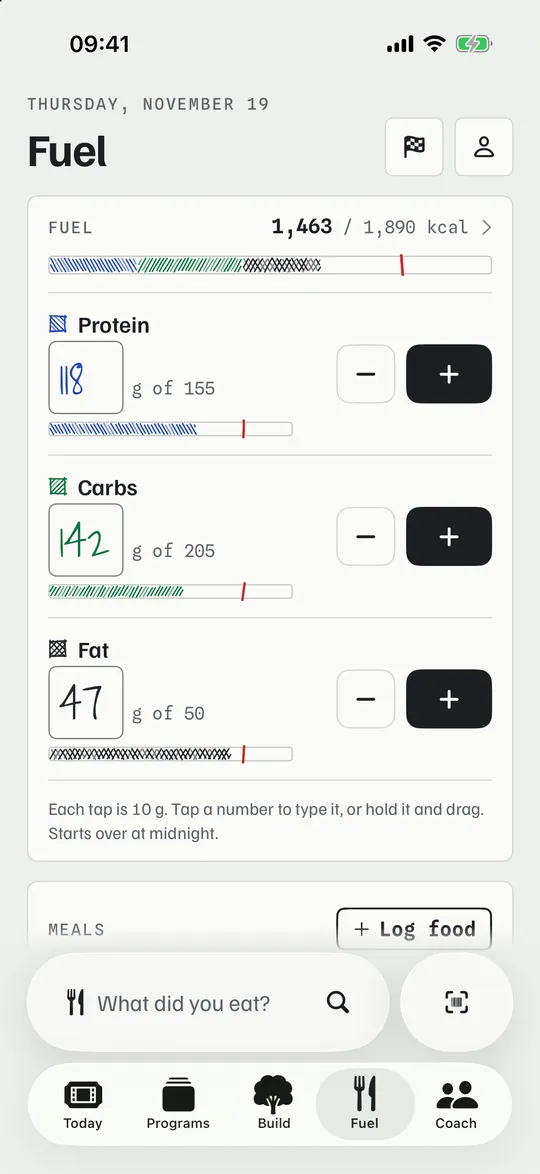
MassBuilder is a training log, not a medical tool. It gives you a strength program that adds weight when your sets go in full, logs every set and shows a graph for each lift, so you see whether your strength holds while the scale goes down. In Fuel, your protein target is set from your goal weight.
Take questions about dose, side effects and whether to stay on the drug to whoever prescribed it.
More questions on the same thing
- How much of the weight you lose on Wegovy is muscle?
- In STEP 1, 38 percent of the weight lost was lean mass, and about half of that is muscle. So roughly 20 percent of the weight lost is estimated to be muscle. The rest of the lean mass is fluid and organs, among other things.
- Do you lose more muscle on Mounjaro than on Ozempic?
- It can't be said for sure. In SURMOUNT-1 with tirzepatide, the drug in Mounjaro, 25 percent of the weight lost was lean mass, against 38 percent in STEP 1 with semaglutide, but the studies had different participants and can't be compared directly. Tirzepatide led to more weight loss at the higher doses, and more weight loss means more kilos of lean mass even when the share is lower.
- Why does muscle matter when you lose weight with Wegovy?
- Your muscles carry you through the day, when you stand up, carry things and climb stairs. A review in Obesity Reviews writes that losing muscle and function can mean worse health and quality of life and lead to weight cycling.
- Does muscle loss on Ozempic slow your metabolism?
- A little. A kilo of muscle burns about 13 kcal a day at rest and a kilo of fat about 4.5, according to measurements in the American Journal of Clinical Nutrition. Two kilos less muscle is about 26 kcal a day. The reason to protect your muscle is strength, not calories.
Sources
- Mozaffarian et al. (2025): Nutritional priorities to support GLP-1 therapy for obesity: A joint Advisory from the American College of Lifestyle Medicine, the American Society for Nutrition, the Obesity Medicine Association, and The Obesity Society. Obesity.
- Wilding et al. (2021): Once-Weekly Semaglutide in Adults with Overweight or Obesity. New England Journal of Medicine.
- Look et al. (2025): Body composition changes during weight reduction with tirzepatide in the SURMOUNT-1 study of adults with obesity or overweight. Diabetes, Obesity and Metabolism.
- Jastreboff et al. (2022): Tirzepatide Once Weekly for the Treatment of Obesity. New England Journal of Medicine.
- Neeland et al. (2024): Changes in lean body mass with glucagon-like peptide-1-based therapies and mitigation strategies. Diabetes, Obesity and Metabolism.
- Mechanick et al. (2025): Strategies for minimizing muscle loss during use of incretin-mimetic drugs for treatment of obesity. Obesity Reviews.
- Wang et al. (2010): Specific metabolic rates of major organs and tissues across adulthood: evaluation by mechanistic model of resting energy expenditure. American Journal of Clinical Nutrition.
This answer was written with Claude and checked against the app (version 4.0) and the sources. Found a mistake? Write to oskar.ege@icloud.com.