Questions and answers · Daily challenge
What is a good daily workout challenge for beginners?
One exercise at a low number, at the same time every day. Choose a number you can manage even on a bad day, such as 5 push-ups or 10 squats, and tie it to something you already do, like breakfast. Plan for sick days so that one missed day does not end the challenge.
Start small enough to do it every day. Kaushal and Rhodes followed 111 new gym members for 12 weeks. Training consistently and keeping it simple predicted that the habit grew. The minimum for a habit to become established was four sessions a week for six weeks.
- 4 sessions a week, at minimum
- 6 weeks in a row, at minimum
- 18 to 254 days until the behavior ran almost on its own
Three choices that keep the challenge going
- A low number. Choose a number you can manage even on a bad day. A rule of thumb: half of what you can do in one go.
- A fixed time. In Lally et al., 96 volunteers did their behavior daily in the same context, such as after breakfast. The time until it ran almost on its own ranged from 18 to 254 days.
- A plan for the days that don't work. In Lally et al., missing one occasion did not materially affect habit formation. Decide in advance what applies when you get ill.
The rule of thumb about the number is our own, not research.
How it looks in MassBuilder
The Daily challenge is an alarm with one exercise and a number from 1 to 100, at the time and on the weekdays you choose. The alarm breaks through silent mode, and Start opens the camera, which counts your reps. From half an hour before the alarm the number cannot be lowered, so you decide it in advance. If the time does not suit you, Move to later works once a day, until 11:50 PM at the latest.
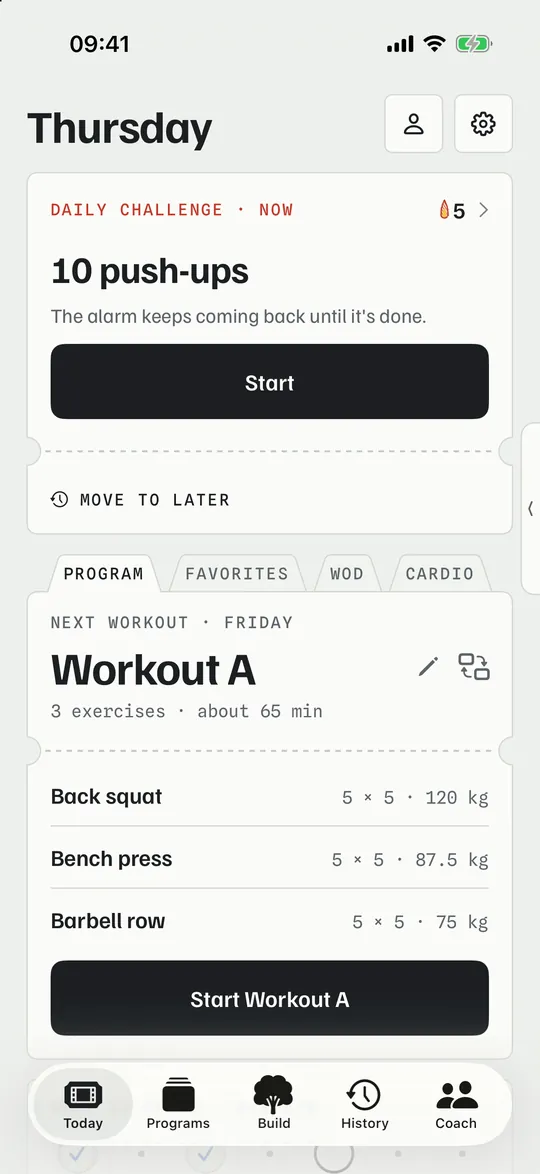
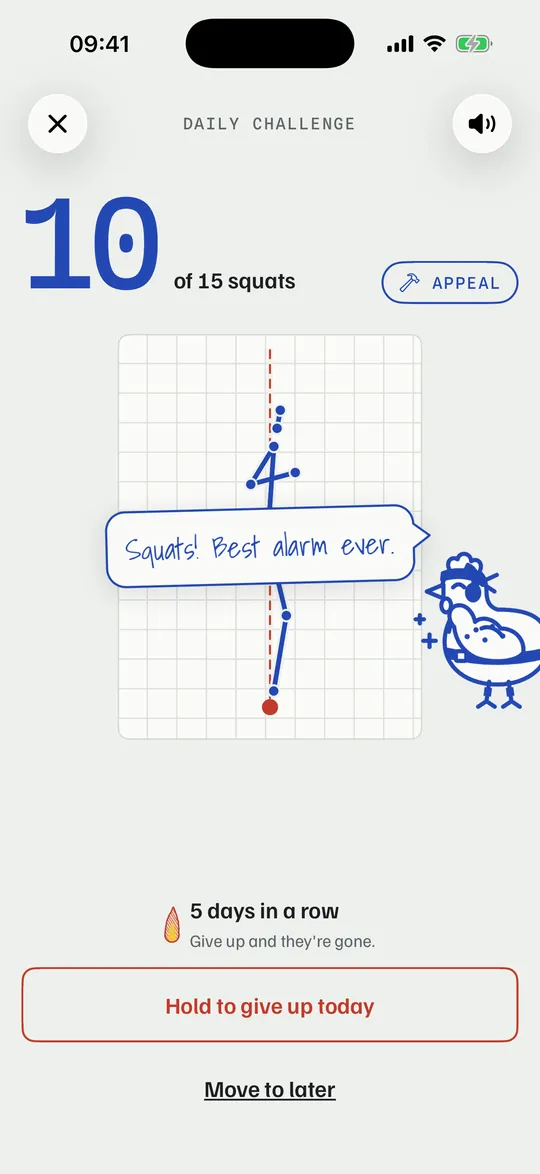
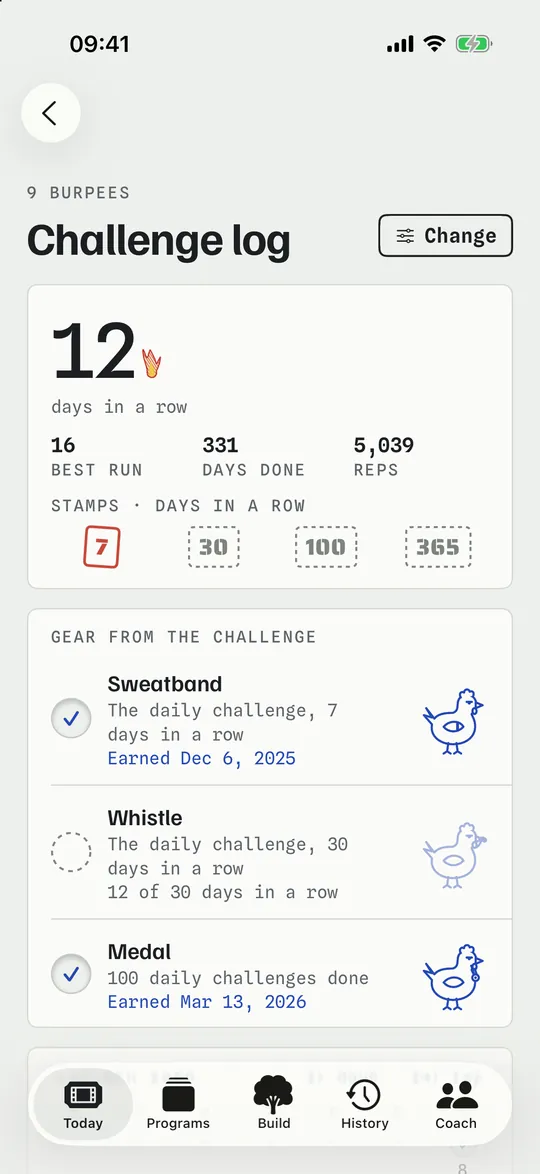
Pause mode is for illness and injury. It costs nothing, lasts one week and can be extended one week at a time. Paused days do not break your streak and do not count toward it either. If you have pain or an injury, ask the person treating you.
What the challenge does not do
A single daily exercise is not a full training program. WHO recommends that adults do muscle-strengthening activity for all major muscle groups on two or more days a week, on top of 150 to 300 minutes of moderate-intensity aerobic activity. But WHO also writes that some physical activity is better than none.
More questions on the same thing
- Which exercise should I choose?
- One you can do without hesitating, wherever you are. The five exercises are compared in the post on which exercise to do every day. If you choose push-ups, your knees may stay on the floor up to the Standard step on the camera's slider.
- How long does it take before it becomes a habit?
- It varies a lot. In Lally et al. it took from 18 to 254 days before the behavior reached 95 percent of its own automaticity. Kaushal and Rhodes found that at least four sessions a week for six weeks were required.
- What happens if I give up one day?
- For the habit, a single missed day matters little according to Lally et al. In MassBuilder you hold the Give up today button for five seconds, and it costs a missed day or whatever you chose in advance. The Challenge log still keeps your best streak, completed days and all your reps.
- Can I pause when I am sick?
- Yes, with Pause mode. It is for illness and injury, costs nothing, lasts one week and can be extended one week at a time. Paused days do not break your streak and do not count toward it. If you have pain or an injury, ask the person treating you when you can start again.
- Can I lower the number on a day when it feels hard?
- Not from half an hour before the alarm until today's challenge is done or given up. Until then you can change both the exercise and the number. You can also do your reps in several rounds during the day, and the count continues where you left off.
- Is a daily challenge enough as training?
- No. WHO recommends muscle-strengthening activity involving all major muscle groups on two or more days a week, in addition to aerobic activity. The Daily challenge is included in the app and is one exercise a day. The circuit, with several exercises, is part of Pro.
Sources
- Kaushal and Rhodes (2015): Exercise habit formation in new gym members: a longitudinal study. Journal of Behavioral Medicine.
- Lally et al. (2010): How are habits formed: Modelling habit formation in the real world. European Journal of Social Psychology.
- Bull et al. (2020): World Health Organization 2020 guidelines on physical activity and sedentary behaviour. British Journal of Sports Medicine.
This answer was written with Claude and checked against the app (version 4.0) and the sources. Found a mistake? Write to oskar.ege@icloud.com.